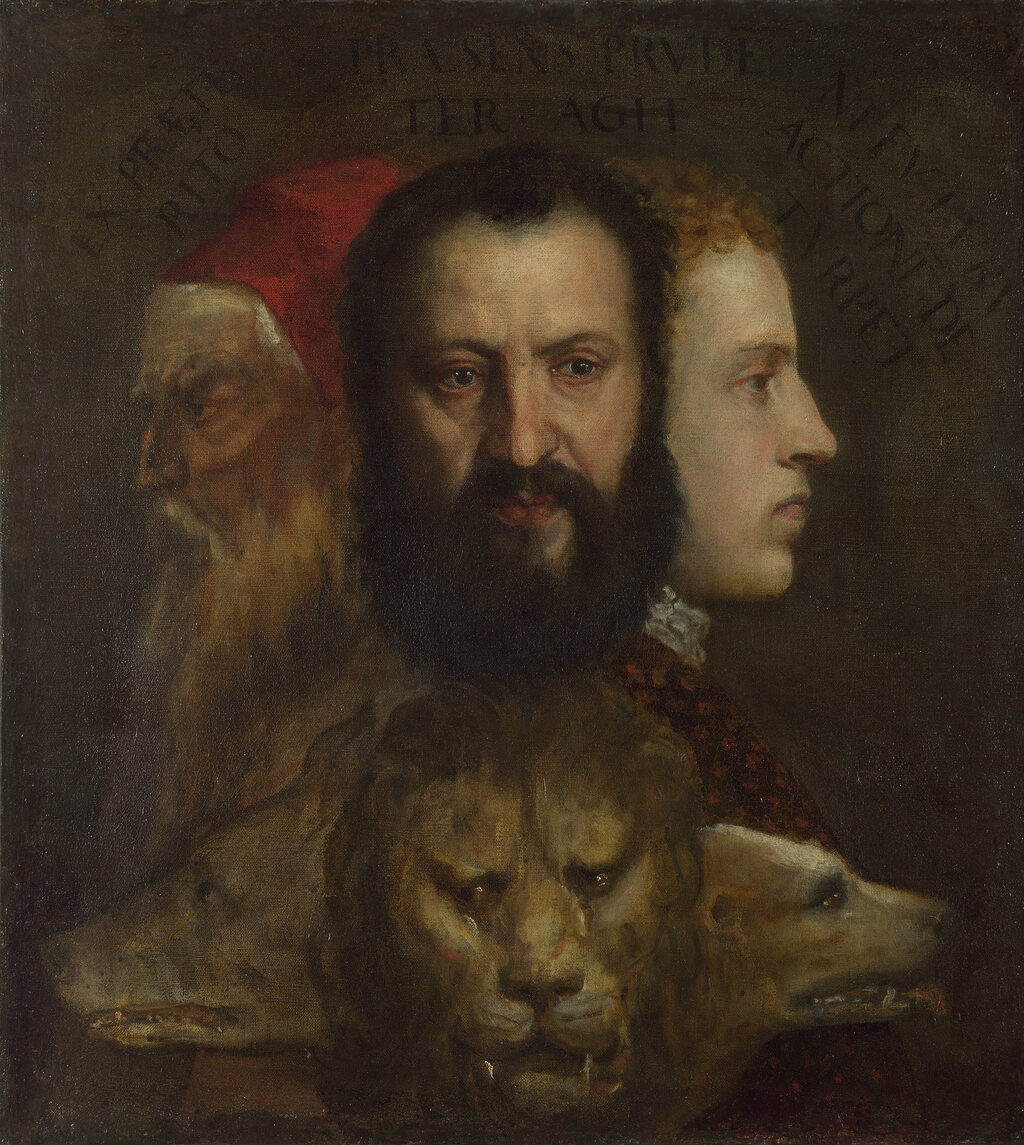
Titian and workshop, An Allegory of Prudence, about 1550 to 1565. The National Gallery, London.
Three faces on one head: what has happened, what is happening, and what is coming.
Wikimedia Commons · Public domain
Spiritual Virtue in the Age of AI and Algorithmic Media
The theological depth behind the method: virtues, gifts, fruits, and charisms, and what each demands of the systems that now form our attention.
Executive Summary
This report uses Catholic theology as the most systematically articulated framework for distinguishing virtues, gifts, fruits, and charisms, while comparing Orthodox, Anglican, Reformed, Wesleyan/Methodist, and Pentecostal/Charismatic emphases. These traditions share a biblical center (especially Isaiah 11, Galatians 5, Romans 12, John 15, and 1 Corinthians 12 to 14) but differ in terminology, sacramental framing, and the relative attention given to sanctification, liturgical reception of the Spirit, or extraordinary spiritual gifts.
The fundamental distinction:
| Category | Core meaning | Primary orientation |
|---|---|---|
| Virtues | Stable dispositions of intellect, will, desire, and action toward the good | The formation of the person |
| Gifts of the Holy Spirit | Spirit-given dispositions that make Christians receptive and responsive to divine guidance | Docility to God |
| Fruits of the Spirit | Perfections and recognizable outcomes of life in the Spirit | Evidence and experience of transformed character |
| Charisms | Diverse Spirit-given capacities for service, mission, and building up the community | The common good |
In Catholic theology, prudence, justice, fortitude, and temperance are cardinal moral virtues; faith, hope, and charity are theological virtues directed immediately toward God. The seven gifts (wisdom, understanding, counsel, fortitude, knowledge, piety, and fear of the Lord) perfect the virtues and dispose the believer to follow the Spirit. The fruits are the mature effects of life in the Spirit. Charisms, whether conspicuous or ordinary, are given not primarily for the recipient's private perfection but for service and ecclesial upbuilding.
AI systems cannot literally possess theological virtues, receive the gifts of the Holy Spirit, manifest sanctifying fruit, or exercise a charism. Those realities pertain to human persons and communities in relationship with God. AI can, however, be designed and governed so that it supports or obstructs human virtue. Catholic reflection on AI warns against equating computational performance with embodied, relational, moral, and spiritual intelligence, and against assigning machines a status or authority that obscures human responsibility.
The central analytical finding is that AI and media should be understood not merely as tools or information channels but as environments of formation. They shape attention (what people repeatedly notice, ignore, fear, desire, and remember), habituation (what responses become easy, automatic, socially rewarded, or emotionally satisfying), social imagination (how people perceive neighbors, enemies, authority, truth, success, and human worth), institutional incentives (what organizations optimize, measure, promote, and tolerate), and practical judgment (whether people retain or surrender the work of discernment).
Empirical research supports concern about these mechanisms. Out-group hostility is a strong predictor of social-media engagement, and an audit of an engagement-ranking system found that it amplified emotionally charged and divisive material more than timelines based on users' stated preferences. This does not prove that all algorithmic media necessarily corrupt character, but it shows that an objective such as engagement can reward patterns contrary to peace, gentleness, temperance, justice, and charity.
A spiritually informed AI-ethics framework should therefore unite three layers:
| Layer | Question | Representative resources |
|---|---|---|
| Moral purpose | What human good, vocation, or common good should this system serve? | Christian virtue ethics, Catholic social teaching, Havard |
| Character and culture | What dispositions must builders, leaders, and users cultivate to act well under pressure? | Virtue ethics, Vallor, Hagendorff |
| Controls and accountability | What rights, technical safeguards, audits, remedies, and governance structures are required? | UNESCO, OECD, NIST, EU AI Act, Rome Call |
Virtue cannot replace law, technical risk management, or institutional accountability. Conversely, compliance cannot replace character. Principles remain aspirational when workers lack honesty, courage, care, prudence, and organizational permission to resist harmful incentives.
Theological Architecture Across Christian Traditions
The categories overlap, but they are not interchangeable. The confusion is common because the English word gift may refer broadly to any divine grace, specifically to Isaiah's sevenfold gifts, or to Pauline charisms such as prophecy, teaching, administration, healing, service, or discernment.
| Category | Definition | Principal sources | Typical examples | Criterion of authenticity | Relevance to AI and media |
|---|---|---|---|---|---|
| Human or moral virtues | Stable, acquired dispositions that order intellect, will, passions, and conduct toward the good | Classical virtue tradition; Catechism 1803 to 1811 | Prudence, justice, fortitude, temperance | Consistent right action according to reason and moral truth | Builders and users need habits of verification, fairness, restraint, courage, and responsible judgment |
| Theological virtues | Infused dispositions by which Christians relate directly to God | 1 Cor 13:13; Catechism 1812 to 1829 | Faith, hope, charity | Deeper communion with God expressed in love of neighbor | Prevents technology from becoming an idol, substitute savior, or ultimate source of meaning |
| Gifts of the Spirit | Spirit-given dispositions that perfect virtue and make the person receptive to divine prompting | Isa 11:2 to 3; Catholic and Anglican confirmation traditions | Wisdom, understanding, counsel, fortitude, knowledge, piety, fear of the Lord | Docility to God, conformity to Christ, sound discernment | Encourages reflective judgment rather than automatic deference to systems |
| Fruits of the Spirit | Mature qualities or perfections produced by life in the Spirit | Gal 5:22 to 23; John 15 | Love, joy, peace, patience, kindness, goodness, faithfulness, gentleness, self-control; the Latin tradition adds generosity, modesty, and chastity | Observable transformation of character and relationships | Provides outcome criteria: does use produce peace, truthfulness, patience, self-command, and loving community? |
| Charisms | Diverse graces or enablements given for service and the common good | Rom 12:3 to 8; 1 Cor 12 to 14; 1 Pet 4:10 to 11 | Teaching, service, leadership, discernment, prophecy, healing, administration, mercy | Love, edification, common good, order, discernment, accountability | Supports role diversity and participatory governance; expertise must serve rather than dominate the community |
Charisms are structurally different from virtues and fruits. A person can possess an impressive capacity to teach, organize, communicate, heal, lead, or persuade while exercising it immaturely or without love. Paul's treatment of Corinth is decisive: manifestations are diverse, are given for the common benefit, and must be ordered by love, intelligibility, mutual edification, and communal discernment. No charism is exempt from discernment.
Technical brilliance, persuasive communication, visionary entrepreneurship, and model-building ability are capacity-like goods, not proof of moral maturity. The presence of highly capable engineers does not establish that a product is just, prudent, truthful, or ordered to human flourishing.
Major Christian perspectives
| Tradition | Characteristic emphasis | Implication for technological ethics |
|---|---|---|
| Catholic | Integration of acquired moral virtue, infused theological virtue, seven gifts, fruits, charisms, sacramental grace, natural law, and the common good | Combine personal formation, institutional discernment, social ethics, and authoritative accountability |
| Eastern Orthodox | Participation in divine life, purification of the passions, ascetic practice, communion, growth into the image and likeness of God | Judge technology by whether it intensifies passions and distraction or supports watchfulness, communion, and freedom |
| Anglican | Scriptural, liturgical, sacramental, and pastoral synthesis; confirmation invokes the sevenfold gifts | Formation occurs through worship and community, not merely private ethical decision-making |
| Reformed | Sanctification by grace through the Spirit; good works as fruit and evidence of living faith, tested by Scripture | Ethical intention must be tested by truth and commanded duties, not by enthusiasm, novelty, or claimed benevolence alone |
| Wesleyan / Methodist | Sanctifying grace, holy love, disciplined growth, Christian perfection as mature love of God and neighbor | Judge technology by whether it strengthens holy love, justice, accountability, and disciplined use |
| Pentecostal / Charismatic | Active expectation of spiritual gifts, empowerment for witness, experiential life in the Spirit; love regulates capacity | Powerful capacities must be governed by love, maturity, order, correction, and service rather than spectacle or influence |
Across these traditions the common principle is clear: capacity is morally underdetermined. It becomes beneficial only when incorporated into truthful judgment, self-command, love, service, communion, and accountability. That principle transfers directly to AI: greater technical capability increases the need for stronger moral formation and governance; it does not reduce it.
Virtuous Leadership
Alexandre Havard rejects the idea that leadership is fundamentally a technique, temperament, public position, or magnetic personality. Leadership is a dimension of character available to people in many stations of life: achieving greatness by bringing out greatness in others.
| Virtue | Leadership function | AI and media application |
|---|---|---|
| Prudence | Perceive reality, deliberate well, choose fitting action | Distinguish evidence from speculation; assess context; resist deploying merely because deployment is possible |
| Courage | Persist in the good despite fear, pressure, difficulty, or cost | Escalate risks, stop launches, protect dissenters, admit incidents, resist revenue pressure |
| Self-mastery | Govern appetite, impulse, emotion, and ego | Resist compulsive use, vanity metrics, hype, haste, surveillance appetite, endless growth |
| Justice | Give persons and communities what is due | Protect rights, privacy, access, fairness, attribution, labor, due process, and affected communities |
| Magnanimity | Aspire to worthy greatness and consequential service | Set a mission larger than market capture, engagement, or technical prestige |
| Humility | Live truthfully about oneself and serve the greatness of others | State model limits, invite correction, share power, listen to affected persons, avoid technological messianism |
Applied to AI, this corrects two opposite failures. Technocratic smallness says: our job is merely to optimize the metric, ship the model, or comply with the rule. Technological grandiosity says: our system will solve education, loneliness, politics, religion, or human meaning. Magnanimity asks whether the project serves a genuinely great human good. Humility asks whether the organization understands its limits, dependencies, externalities, and responsibility to people who did not choose the system. Humility without magnanimity can become timidity; magnanimity without humility becomes domination.
The Two Works Called Media Mindfulness
| Work | Author | Orientation | Core contribution |
|---|---|---|---|
| Media Mindfulness: Educating Teens About Faith and Media | Gretchen Hailer, RSHM, and Rose Pacatte, FSP | Catholic media literacy and faith formation | Critical inquiry into constructed media messages, combined with Gospel values and theological reflection |
| Media Mindfulness: Building a Balanced Diet for the Brain | William Indick | Media psychology and environmental self-management | Deliberate balancing of media environments to protect attention and mental, emotional, physical, and spiritual health |
Hailer and Pacatte define media mindfulness as critical thinking about media joined to Gospel values. Media messages are constructed rather than transparent windows onto reality; they select, frame, omit, symbolize, and communicate values. The appropriate response is neither uncritical consumption nor blanket denunciation, but inquiry, reflection, dialogue, and discerning action. A concise form of their method:
| Movement | Guiding questions |
|---|---|
| Attend | What did I see, hear, feel, and desire? What captured my attention? |
| Analyze | Who created this? For whom? By what techniques? What is selected or omitted? |
| Interpret | What view of happiness, identity, success, relationships, power, or truth is communicated? |
| Discern | How does this compare with the Gospel, human dignity, solidarity, justice, and the common good? |
| Respond | Should I accept, reject, reinterpret, discuss, correct, share, create, or abstain? |
Indick approaches media as psychological environments that shape modes of attention, behavior, and thought. Media mindfulness is not total disengagement but deeper awareness of how linguistic, numerical, musical, bodily, natural, and digital environments affect human functioning, with emphasis on changing patterns of engagement rather than assuming insight alone will overcome unhealthy habits.
The accounts synthesize into four questions. Hailer and Pacatte ask: what does this media message mean, what values does it carry, and how should faith respond? Indick asks: what kind of attentional and psychological environment am I inhabiting, and what is repeated exposure doing to me? Virtue ethics asks: what kind of person am I becoming through this pattern of attention and action? AI governance asks: who designed this environment, what does it optimize, who benefits, who bears risk, and what remedies exist?
AI and Media as Environments of Formation
AI and algorithmic media challenge virtue not because technology is intrinsically opposed to spiritual life, but because these systems intervene at the points where character is formed: attention, repetition, imagination, relationship, judgment, and social reward. Pope Francis named this condition directly: "all of us, but especially the young, are immersed in a culture of zapping," and "without the wisdom of discernment, we can easily become prey to every passing trend" (Gaudete et Exsultate 167). He also named its ecclesial form: verbal violence "even in Catholic media" (115). Holiness, in his account, now passes through the discernment of screens.
| Mechanism | Virtue risk | Potential virtue-enabling use |
|---|---|---|
| Personalized attention capture | Distraction, intemperance, envy, anger, compulsive checking | User-controlled feeds, quiet defaults, intentional sessions, reminders of stated purposes |
| Engagement optimization | Rewards outrage, sensationalism, tribalism, premature reaction | Optimize for reflective satisfaction, learning, constructive dialogue, completed human goals |
| Generative fluency | Confuses plausibility with truth; encourages intellectual passivity | Drafting, translation, brainstorming, accessibility, comparison of viewpoints |
| Anthropomorphic interaction | Misplaced trust, emotional dependency, false authority | Transparent role framing, non-deceptive interfaces, reminders of limits and human support |
| Automation of judgment | Automation bias, deskilling, evasion of responsibility | Decision support with explanations, uncertainty, alternatives, appeals, accountable human review |
| Scale and speed | Errors, defamation, bias, or manipulation propagate rapidly | Rapid access to knowledge, crisis communication, accessibility, broad participation |
| Data extraction | Surveillance, commodification, violations of privacy and dignity | Data minimization, privacy-preserving analysis, user control, socially beneficial research |
| Synthetic content | Impersonation, fraud, epistemic confusion, reputational injury | Educational simulation, creative production, language access, assistive communication |
| Metric visibility | Vanity, comparison, conformity, status competition | Meaningful feedback, community coordination, transparent quality indicators |
| AI-mediated spiritual content | Fabricated doctrine, counterfeit authority, replacement of community or pastoral care | Search assistance, study guides, translation, retrieval of primary sources, prompts for human reflection |
An AI system's apparent linguistic competence can obscure the difference between generating an answer and possessing practical wisdom. Antiqua et Nova argues that human intelligence is embodied, relational, affective, social, moral, and open to truth and the good in ways not captured by computational task performance. Four consequences follow:
- AI can simulate counsel without possessing the gift of counsel. It may present options or retrieve traditions, but it cannot replace conscience, prayer, lived experience, pastoral responsibility, or communal discernment.
- AI can produce kindness-like language without possessing charity or the fruit of kindness. The moral quality of the interaction depends on the intentions, design, truthfulness, consequences, and human relationships surrounding it, not merely its tone.
- AI can classify ethical concepts without possessing prudence. Prudence is not rule retrieval; it requires perception of morally salient particulars, rightly ordered desire, experience, and accountable choice.
- AI may extend a human charism without receiving a charism. A gifted teacher, translator, administrator, artist, or evangelist may use AI to extend service, but the tool itself is not the spiritual recipient.
Challenges to particular virtues and fruits
| Spiritual quality | Characteristic AI/media challenge | Virtue-forming counterpractice |
|---|---|---|
| Faith | Technological solutionism; treating predictive capacity as omniscience | Preserve theological and epistemic humility; distinguish created tools from ultimate truth and salvation |
| Hope | Catastrophism, fatalism, or utopian promises | Practice realistic hope: acknowledge risk while preserving human agency, responsibility, and reform |
| Charity | Dehumanization, parasocial substitution, harassment, indifference to distant harms | Ask who is concretely served, neglected, stereotyped, displaced, or made vulnerable |
| Prudence | Speed, information overload, opaque recommendations, fabricated certainty | Slow consequential decisions; verify primary evidence; display uncertainty and alternatives |
| Justice | Biased datasets, unequal access, labor exploitation, inaccessible appeals | Impact assessment, representative testing, accessibility, due process, benefit-sharing |
| Fortitude | Organizational silence, conformity, fear of missing the market | Protected dissent, escalation channels, stop-ship authority, whistleblower safeguards |
| Temperance | Infinite scroll, notifications, variable rewards, compulsive creation | Finite sessions, quiet defaults, intentional limits, friction, periodic abstinence |
| Humility | Founder mythology, model anthropomorphism, overclaiming, refusal to correct | Limit statements, external review, incident disclosure, correction records |
| Magnanimity | Reducing success to growth, valuation, scale, or attention | Define a mission in terms of durable human goods and service |
| Peace | Polarization and conflict as engagement engines | De-amplify hostility; reward constructive disagreement; introduce reflection before sharing |
| Patience | Expectation of instantaneous answers and relationships | Allow uncertainty, research, human response time, and processes of maturation |
| Gentleness | Performative outrage, ridicule, humiliation, aggressive persuasion | Non-coercive design, respectful moderation, proportionate interventions |
| Faithfulness | Ephemeral commitments, unattributed reuse, silent model changes | Provenance, promises that can be audited, stable policies, version histories |
| Self-control | Outsourcing memory, writing, choice, or emotional regulation by default | Use AI selectively; retain regular unaided practice and deliberate decision points |
The empirical evidence on engagement systems illustrates why temperance and peace matter at the design level. Hostile references to political out-groups are especially engagement-producing, and a preregistered audit found that engagement-based ranking amplified more emotionally charged, partisan, and out-group-hostile content than a chronological feed or a ranking based on users' stated preferences. The ethical problem is therefore not reducible to bad users; it also concerns what the system makes easy, visible, and rewarding.
AI can nevertheless support virtue when it functions as a scaffold rather than a substitute: presenting counterarguments before publication, helping users identify unsupported assertions, translating materials for underserved communities, making documents accessible, prompting reflection on affected stakeholders, retrieving primary theological sources, or structuring a post-incident examination.
An Integrated Ethical Framework
Virtue ethics asks a question often neglected by rule-centered frameworks: what must human beings and organizations become in order to use power well, especially when rules are incomplete and incentives are adverse? Shannon Vallor argues that rapidly changing technosocial conditions require cultivated qualities such as honesty, self-control, humility, justice, courage, empathy, care, civility, perspective, flexibility, magnanimity, and integrating practical wisdom. Thilo Hagendorff makes this operational for AI practice: justice, honesty, responsibility, and care as basic dispositions, with prudence and fortitude as second-order virtues needed to perceive the right course and act despite pressure or institutional resistance.
| Virtue, gift, fruit, or charism principle | AI/media ethical principle | Concrete design or governance expression |
|---|---|---|
| Human dignity and charity | Human-centeredness; do no harm; protection of rights | Prohibit uses that instrumentalize persons; assess effects on vulnerable groups; provide meaningful remedy |
| Prudence, wisdom, counsel | Contextual risk assessment; proportionality; explainability | Document intended use, foreseeable misuse, uncertainty, alternatives, thresholds for human review |
| Justice | Fairness, nondiscrimination, accessibility, due process | Representative evaluations, subgroup analysis, accessible interfaces, appeals, correction and compensation |
| Honesty and faithfulness | Transparency, provenance, traceability | Disclose AI interaction; identify synthetic media; cite sources; maintain logs and version histories |
| Fortitude and courage | Accountability and ethical escalation | Independent review, protected dissent, stop-work authority, mandatory incident reporting |
| Temperance and self-control | Non-manipulation; autonomy; proportional data use | Avoid compulsive patterns; limit notifications; minimize data; provide meaningful user controls |
| Humility and fear of the Lord | Epistemic humility; human oversight | Calibrated confidence, limitation statements, external audit, no false claims of consciousness or authority |
| Magnanimity and hope | Beneficial purpose; inclusive flourishing | Define success by human capability and community benefit, not merely engagement or revenue |
| Peace, patience, gentleness | Information integrity; civic health; safe interaction | Add sharing friction, contextualize conflict, support respectful disagreement, resist outrage optimization |
| Kindness and care | Relational responsibility and welfare | Safeguards for distress, age-appropriate design, pathways to qualified human support |
| Charisms ordered to the common good | Participatory and multidisciplinary governance | Include technical, ethical, legal, pastoral, domain, worker, and affected-community expertise |
| Discernment of charisms | Evaluation, contestability, independent assurance | Test claimed benefits, motives, business incentives, adverse effects, conformity to institutional mission |
| Fruits of the Spirit | Outcome and culture evaluation | Measure whether deployment increases trust, agency, constructive participation, patience, equitable benefit |
This mapping is analogical, not an equation of theology with compliance. The Rome Call, the UNESCO Recommendation, the OECD Principles, the NIST AI Risk Management Framework, and the EU AI Act operate in legal, policy, or professional registers. They do not confer spiritual virtue. They nevertheless encode principles substantially consonant with dignity, justice, truthfulness, responsibility, solidarity, prudence, and care.
Why virtue and compliance need each other
A principle-only approach can fail because principles are abstract and may conflict in concrete cases; organizations can formally comply while manipulating scope, metrics, or documentation; workers may recognize a problem yet lack courage or authority to act; incentives may reward silence, speed, engagement, and market capture; and unforeseen situations require judgment rather than mechanical rule application.
A virtue-only approach can also fail because good intentions do not eliminate bias, error, power asymmetry, or structural harm; character judgments can become subjective or protect charismatic leaders from scrutiny; affected people need enforceable rights, not confidence that developers are benevolent; complex systems require measurement, documentation, audit, technical assurance, and remedy; and organizational incentives can overwhelm individual virtue.
The stronger architecture: virtuous purpose + formed practitioners + accountable institutions + technical controls + enforceable rights + continual evaluation of outcomes.
Cases and Historical Lessons
Corinth as an early governance case
The Corinthian controversy in 1 Corinthians 12 to 14 can be read as an early case of governing powerful, unevenly distributed capacities within a community. Paul does not abolish gifts because they can be misused. Instead, he establishes an ordered framework:
| Corinthian principle | Contemporary AI parallel |
|---|---|
| Gifts have a common source but diverse forms | Technical, domain, legal, ethical, and community expertise are different but interdependent |
| Manifestations are given for the common benefit | Capability must serve human and social goods rather than private status |
| No member can declare another unnecessary | Engineers, users, workers, and affected communities must not be excluded from governance |
| Spectacular ability without love is spiritually empty | Benchmark performance does not establish ethical legitimacy |
| Speech must be intelligible and orderly | Explainability, documentation, role clarity, and disciplined deployment matter |
| Others must be able to weigh what is offered | Independent evaluation and contestability are necessary |
| The speaker remains responsible for use of the gift | A developer or deployer cannot evade responsibility by blaming the algorithm |
The lesson for AI is that plural expertise requires both freedom and order. Innovation should not be extinguished, but neither may capability exempt itself from discernment. The more excellent way is not anti-technical; it is the governance of technical gifts by love and the common good.
Engagement ranking and the vice of the objective function
A 2025 audit of an engagement-ranking system provides a contemporary case in which the optimization target itself became morally formative. Engagement ranking selected more divisive, emotionally charged, and out-group-hostile posts than users said they preferred. The platform did not need an intention to cultivate hostility; the combination of objective function, behavioral signals, and human vulnerabilities was sufficient to amplify it. A system can generate no explicitly prohibited item and nevertheless produce a harmful ecology through repeated selection and reward. Virtue-oriented evaluation therefore asks: What behavior does the metric reward? What emotional states increase system success? What dispositions become easier through repetition? Does the system privilege immediate impulse over reflective preference? Who becomes visible as a neighbor, rival, object, threat, or commodity? What would count as a good fruit after six months of use?
Catholic media teaching as a historical continuity
The Second Vatican Council's Inter Mirifica recognized that mass media influence not only individuals but entire societies. Communio et Progressio emphasized media's capacity to advance human development, solidarity, and proclamation, and later Church documents addressed the internet as a new field of communication, education, participation, and moral responsibility. This history cautions against two simplifications: technological rejection (the Church has repeatedly affirmed media's potential for education, evangelization, solidarity, and progress) and technological innocence (because media shape culture and consciousness, users, creators, institutions, and authorities have corresponding duties of formation, truthfulness, justice, and responsibility). Pope Francis extended this tradition to AI, arguing that AI should serve the highest human potential rather than compete with it, and calling for a wisdom of the heart capable of integrating technology into fully human communication.
The Rome Call in organizational practice
Providence, a United States healthcare organization, became a Rome Call signatory and implemented it through ethical guidelines, discernment practices, ethics consultations, research, and a dedicated AI ethics subcommittee. A virtue statement becomes operational only when attached to named decision-makers, recurring review, access to domain and ethics expertise, escalation and consultation mechanisms, documentation, research and evaluation, and responsibility for revising practices. The limitation is equally instructive: voluntary frameworks depend on internal commitment and external scrutiny, and should complement rather than substitute for legal duties, professional standards, procurement conditions, audits, and rights of appeal.
Practical Integration Roadmap
The same path applies to an AI project and, at a smaller scale, to personal media habits:
- Name the human good and true purpose.
- Identify people, communities, and vulnerable groups affected.
- Select the virtues, gifts, and fruits most relevant to the context.
- Map risks to dignity, truth, justice, attention, freedom, and communion.
- Translate virtues into product requirements, habits, and accountable roles.
- Test with affected users, domain experts, and adversarial reviewers.
- Ask: are the legal, technical, and virtue thresholds met? If not, return to step 4.
- Deploy gradually with meaningful human oversight.
- Monitor harms, benefits, and formative outcomes.
- Conduct an examen, repair incidents, and revise incentives. Repeat.
Personal practice: a rule of life for AI and media
| Practice | Concrete implementation | Virtue cultivated |
|---|---|---|
| State the intention before opening | Complete the sentence: I am using this tool now in order to... | Prudence, temperance |
| Use finite sessions | Set a defined task and stopping point rather than entering an open-ended feed | Self-control |
| Separate generation from judgment | Let AI draft or brainstorm, then close it and evaluate independently | Prudence, intellectual humility |
| Verify consequential claims | Check medical, legal, financial, theological, historical, and reputational claims against primary sources | Honesty, justice, faithfulness |
| Label certainty | Mark notes as fact, inference, proposal, unresolved question, or AI-generated language | Honesty |
| Pause before sharing | For emotionally activating content, delay, reread, verify, and ask whom the post serves | Patience, peace, gentleness |
| Retain unaided capacities | Regularly write, reason, pray, remember, create, and converse without AI assistance | Fortitude, self-mastery |
| Protect sacred and relational spaces | Keep meals, worship, confession, spiritual direction, and family periods device-light or device-free | Charity, piety, presence |
| Practice periodic abstinence | Notification-free periods, a weekly media Sabbath, or an app-specific fast | Temperance, freedom |
| Conduct a weekly examen | Review attention, emotions, truthfulness, relationships, harms, benefits, and corrective action | Wisdom, counsel, humility |
A useful weekly examen: What repeatedly captured my attention? What did I come to love, fear, envy, or despise? When did AI increase understanding or service? When did it make me passive, hurried, vain, harsh, or less present? What fruits appeared in my relationships? What truth needs correction, what harm needs repair, and what habit should change?
AI may assist by organizing the examination or retrieving records, but it should not be treated as confessor, spiritual director, authoritative interpreter of providence, or substitute for a trustworthy human and ecclesial relationship.
Organizational leadership
| Leadership practice | Operational requirement | Rationale |
|---|---|---|
| Mission test | Every AI proposal states the human good served, why AI is appropriate, and what non-AI options were considered | Magnanimity and prudence |
| Virtue charter | Link dignity, justice, honesty, care, courage, and humility to observable behaviors and controls | Character must become practice |
| Distributed discernment | Include affected users, domain experts, legal and security teams, ethicists, frontline workers, community representatives | Charisms are diverse and ordered to the common good |
| Protected dissent | Confidential escalation, anti-retaliation rules, stop-ship authority | Fortitude |
| Truthful communication | Ban unsupported capability claims; disclose limitations, evaluation scope, incidents, material changes | Honesty and humility |
| Incentive alignment | Evaluate leaders on safety, correction, user welfare, mentorship, and trust, not only speed or growth | Justice and self-mastery |
| Incident repair | Notification, containment, remediation, apology, compensation, and learning procedures | Justice, faithfulness, charity |
| Leadership formation | Case reflection, ethical rehearsals, mentoring, stakeholder encounters, postmortems | Virtue develops through repeated practice |
| Governance independence | Reviewers with information access and authority independent of the product's revenue owner | Prudence and accountability |
| Formation metrics | Track reflective satisfaction, user agency, reliance, correction, conflict quality, accessibility, distribution of benefit | Evaluate fruits, not merely outputs |
Protected dissent is particularly important. An organization does not possess fortitude merely because its values page praises courage. Fortitude exists organizationally when employees can delay or stop a harmful launch without predictable career punishment, and when leaders publicly reward truth-telling before a crisis rather than praising whistleblowers after one. Humility likewise requires structures: external evaluation, red-team access, consultation with people outside the product team, limitation statements, uncertainty reporting, and willingness to abandon a technically impressive system when the use case is not socially justified.
AI product and design practice
- Purpose and limits. State the human capability the system should strengthen and the decisions it must not make. Specify contexts in which the system is inappropriate, including uses requiring pastoral, clinical, judicial, or fiduciary judgment.
- Truth and provenance. Distinguish generated content from verified information. Support citations, source inspection, change histories, and correction. Do not use a confident conversational style to conceal uncertainty.
- Meaningful human oversight. Define what the human reviewer knows, can inspect, can override, and is accountable for. A nominal human in the loop who lacks time, authority, competence, or alternatives does not constitute meaningful oversight.
- Friction at morally significant moments. Add pauses, confirmations, counterevidence, or secondary review before publishing high-reach content, impersonating a person, making consequential decisions, or transferring sensitive data.
- Non-manipulative interaction. Avoid deceptive anthropomorphism, false claims of feelings or consciousness, coercive emotional attachment, shame-based retention, and designs that imply spiritual or moral authority.
- Privacy and restraint. Collect the minimum data necessary, offer understandable controls, limit retention, protect sensitive inferences, and make the privacy-preserving path the default.
- Care for vulnerable users. Age-appropriate design, crisis escalation, accessibility, clear boundaries, and routes to qualified human assistance. Include vulnerable groups in testing and governance.
- Reflective preference. Measure not only what people click but what they endorse after reflection, whether the interaction completed their stated purpose, whether they regret the use, and whether the system strengthened or weakened agency.
- Continuing evaluation. Monitor changes in use, population, model behavior, downstream integration, and organizational incentives across the lifecycle.
Governance and Policy
A virtue-informed public policy does not attempt to legislate holiness. It creates the conditions in which truthful, just, prudent, and responsible conduct is possible, and in which vice, negligence, manipulation, and abuse encounter meaningful constraints.
| Governance objective | Recommended policy mechanism | Virtue alignment |
|---|---|---|
| Preserve human responsibility | Prohibit claims that the AI decided; assign accountable providers and deployers | Responsibility, justice |
| Make consequential systems contestable | Notice, explanation, access to records, human reconsideration, remedy | Justice, counsel |
| Protect epistemic integrity | Synthetic-content disclosure, provenance standards, impersonation remedies, researcher access | Honesty, faithfulness |
| Constrain manipulation | Rules for dark patterns, emotional exploitation, children's design, deceptive anthropomorphism | Temperance, care |
| Govern high-risk uses proportionately | Predeployment impact assessment, conformity review, monitoring, incident reporting | Prudence |
| Protect privacy and freedom | Data minimization, purpose limitation, sensitive-inference restrictions, security requirements | Justice, self-mastery |
| Strengthen worker courage | Whistleblower protection, professional independence, protected escalation | Fortitude |
| Include affected communities | Participatory impact assessment, community consultation, accessible public reporting | Humility, solidarity |
| Address objective functions | Require evaluation of ranking, recommendation, and optimization goals, not only individual outputs | Prudence, peace |
| Use procurement as leverage | Government, healthcare, education, and church purchasers require documentation, audit, accessibility, remedies | Justice, stewardship |
| Evaluate social and environmental costs | Energy, labor, supply-chain, displacement, and distributional assessments | Care, solidarity, common good |
| Support plural governance | Technical experts, ethicists, labor, civil society, religious communities, vulnerable groups | Diversity of charisms |
A recurrent policy error is to regulate only model outputs while leaving the underlying business objective untouched. A platform can remove particular harmful posts while retaining an optimization system that systematically rewards outrage, compulsive attention, or polarization. Governance must therefore examine recommender objectives, advertising incentives, data practices, interface patterns, and the distribution of power. Pope Francis specifically argued that AI-regulation debates must include those commonly unheard in global decision-making, including poor and powerless persons. This corresponds to justice, humility, solidarity, and the Pauline insistence that apparently weaker members of the body cannot be treated as dispensable.
Priority Reading
| Area | Source | Why it matters |
|---|---|---|
| Biblical foundation | Isaiah 11:1 to 3; Galatians 5:13 to 26; Romans 12:3 to 21; 1 Corinthians 12 to 14; John 15 | Primary texts for the sevenfold Spirit, fruit, charisms, common good, love, discernment, and abiding fruitfulness |
| Catholic virtue theology | Catechism of the Catholic Church, 1803 to 1845 | Concise official treatment of human virtues, theological virtues, gifts, and fruits |
| Catholic charisms | Catechism 798 to 801; Iuvenescit Ecclesia | Charisms as diverse graces for mission and the common good, subject to discernment |
| Orthodox spirituality | OCA, The Orthodox Faith, "The Virtues" | Connects virtues and fruits to image, likeness, ascetic freedom, and holistic formation |
| Anglican gifts | Church of England confirmation liturgies | The sevenfold gifts embedded in worship and ecclesial formation |
| Reformed sanctification | Westminster Shorter Catechism Q.35; Westminster Confession ch. 16 | Renewal of the whole person; good works tested by Scripture rather than intention alone |
| Wesleyan holiness | UMC Articles and Confession of Faith; Distinctive Wesleyan Emphases | Sanctification, disciplined growth, and perfect love of God and neighbor |
| Pentecostal gifts and fruit | Assemblies of God resources on gifts, fruit, and the Church | Gifts and fruits as complementary, with love regulating capacity |
| Virtuous leadership | Alexandre Havard, Virtuous Leadership | Six-virtue synthesis of character, aspiration, judgment, and service |
| Catholic media mindfulness | Gretchen Hailer and Rose Pacatte, Media Mindfulness: Educating Teens About Faith and Media | Integrates critical media literacy, Gospel values, theological reflection, and active response |
| Psychological media mindfulness | William Indick, Media Mindfulness: Building a Balanced Diet for the Brain | Media as environments that shape attention, behavior, and psychological balance |
| Christian communication ethics | Inter Mirifica; Communio et Progressio; The Church and Internet | Historical development of Christian reflection on media's social power |
| Holiness in the digital age | Francis, Gaudete et Exsultate, especially 115 and 167 | Names the culture of zapping, digital verbal violence even in Catholic media, and discernment as the remedy |
| Theological anthropology and AI | Antiqua et Nova | The most substantial official Catholic treatment of AI, human intelligence, dignity, and responsibility |
| AI and communication | Francis, "Artificial Intelligence and the Wisdom of the Heart" | Connects AI-mediated communication with wisdom, humanity, truth, and social relationship |
| Technology and virtue ethics | Shannon Vallor, Technology and the Virtues | Major philosophical account of technomoral virtues for uncertain technological societies |
| Applied AI virtue ethics | Thilo Hagendorff, "A Virtue-Based Framework to Support Putting AI Ethics into Practice" | Bridges the principle-to-practice gap through justice, honesty, responsibility, care, prudence, fortitude |
| Global AI ethics | UNESCO Recommendation on the Ethics of Artificial Intelligence | Human-rights-centered global framework for dignity, inclusion, safety, and oversight |
| Operational risk management | NIST AI Risk Management Framework and Generative AI Profile | Practical lifecycle governance: Govern, Map, Measure, Manage |
| International policy principles | OECD AI Principles | Human-centered values, transparency, safety, fairness, accountability |
| Faith-linked AI principles | Rome Call for AI Ethics | Direct bridge from human dignity and service to transparency, inclusion, responsibility, impartiality, reliability, security, and privacy |
| Binding risk regulation | European Union AI Act materials | Leading example of enforceable, risk-based AI regulation |
| Algorithmic media evidence | Rathje et al., "Out-group animosity drives engagement"; Milli et al., "Engagement, user satisfaction, and the amplification of divisive content" | Empirical basis for treating engagement incentives as formative moral and civic structures |
AI should not be evaluated only by what it can produce, but by what its creation and use ask human beings to love, notice, practice, tolerate, become, and build together.
A project ordered toward virtue therefore evaluates at least four kinds of fruit: the quality of the artifact, the character and culture of its builders, the agency and relationships of its users, and the justice and flourishing of the wider community. Technical excellence is one good among these, not their substitute and not their judge.